Wednesday, July 31, 2013

Salvaging Shakespeare, and Me


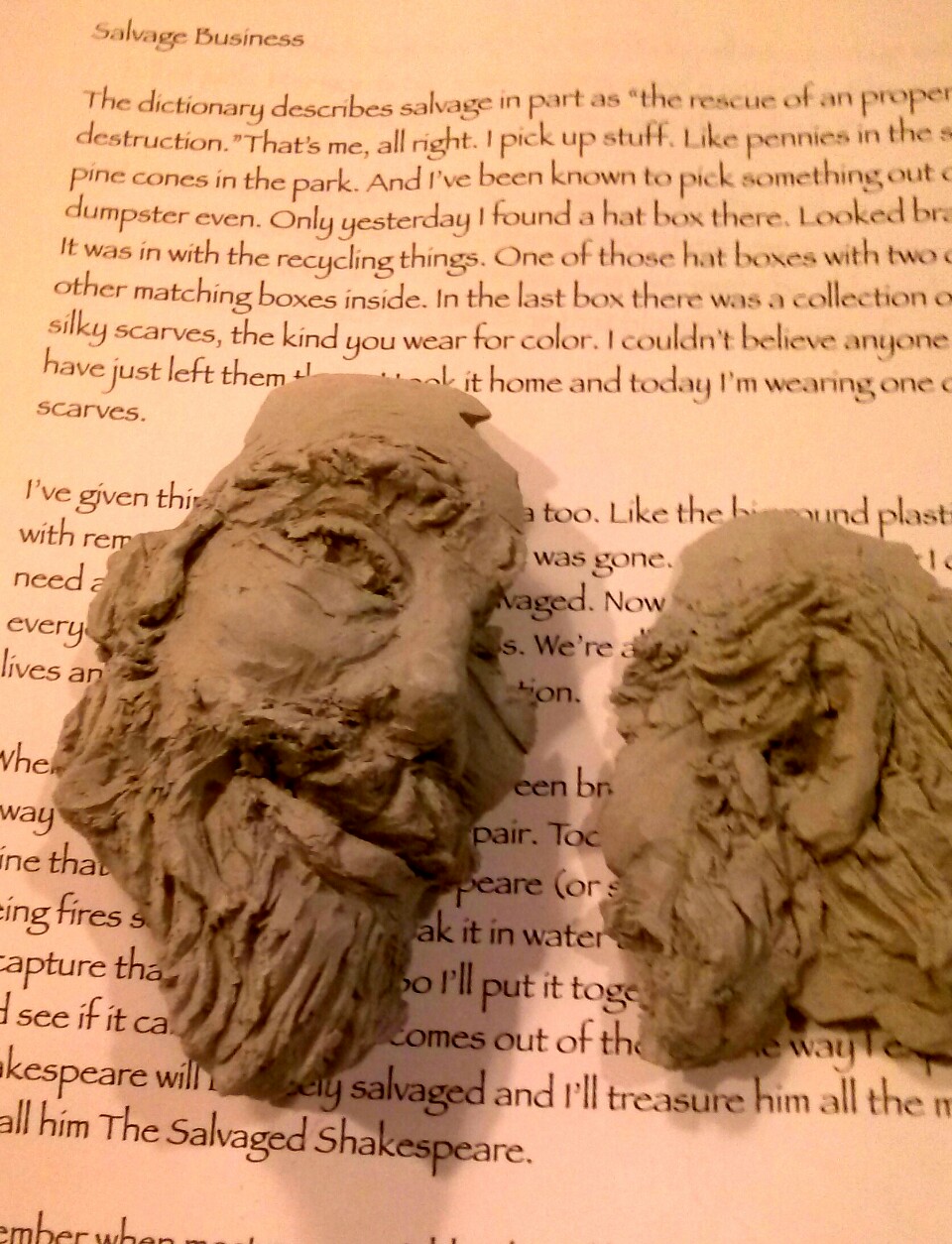
When something I’ve treasured has been broken it’s not in me to throw it away unless it’s broken beyond repair. Today I’m working on a sculpture of mine that looked just like Shakespeare (so I imagine.) That's it, up at the top of this page. It broke before being fired so I could have simply soaked it in water and punched it back into a lump of clay to start over, but I could never recapture that first likeness. I’ll try to put it together with some slip (wet clay) and see if it can be fired. If it comes out of the kiln the way I expect, my Shakespeare will be salvaged and I’ll treasure him all the more. Maybe I’ll call him The Salvaged Shakespeare.

The dictionary defines salvage in part as “the rescue of a property from destruction.” That’s me, all right. I pick up stuff. Like pennies in the street or pine cones in the park. And I’ve even been known to pick up something out of a dumpster. Only yesterday I found a hat box there. Looked brand new. It was in with the recycling things. One of those hat boxes with two or three other matching boxes inside. In the last box there was a collection of silk scarves, just the kind I’ve been looking for in the stores. Not the long ones so popular today but simply long enough to add a touch of color to my mostly black and white wardrobe. To think if it had gone into the truck!

I’ve given things to the dumpster area too. Like the big round plastic table with removable legs. In half an hour it was gone. It was something I didn’t need anymore and now it’s been salvaged. Now that I think of it almost everyone is in the salvage business. We’re all picking up the pieces of our lives and sometimes others,' rescuing them from destruction. Or we should be.

Remember when almost every neighborhood had a vacant lot where people would dump things? My brother, Danny, found an old broken baby carriage in one when he was a kid and used the wheels for a go-cart he’d built. My sister-in-law tells how, when she was about five or six, she came home one day all tousled and smudged with her arms full of junk. Her first words to her mom preempted a scolding. She said, with a broad smile, “Just look, Mommy, I found a nice clean dump!”

Working on Shakespeare got me to thinking. There’s something poignant and pathetic about the broken pieces of life. We’d like to salvage them, mend them, make them new again. Since we can’t turn back the clock and prevent their pain, we might be able to do that at least. Even if they seem beyond repair, our lives can be salvaged. Like unfired clay they can go back and be carved again.

Years ago when Wally and I lived near a Marine base, a friend of ours, a man whom we knew to be kind and gentle, who ministered to new recruits in the Marine Corps, told us he had lived a rugged life. He had lost one eye to show for it and had in its place a glass eye which made it hard to remember which eye to look at as we conversed. He told us how he’d been digging in his back yard garden that day.

“I still live in the house I grew up in,” he said, “and when my shovel hit something hard I reached down to pick it up and when I rubbed the dirt away what should I find but a little white ceramic lamb that I had treasured and lost in my childhood. I took it in to the kitchen sink and washed it off." At this point his one good eye misted up but he went on. "I saw that it was without blemish of any kind, just as pure and white as it was back then.” He didn’t need to spell out the rest. We knew he had found redemption. He’d salvaged his life and was helping others to salvage theirs.

I’m thinking today that all our lives are in the process of either being broken or salvaged. Probably both in any given day. Somehow we are not permitted to linger in between the two. We’re either going up or down, forward or backward. Salvaging and salvation are not just God’s business, we must at some time see them as our business too and be engaged. Nobody can say it’s easy, but the joy of finding ourselves as pure as that little white lamb is our reward if we persevere. 

I see us all as children rummaging through “a nice clean dump,” hoping to find treasures and then going home to take a bath and finding that we are the treasure we’re looking for. It’s a messy business, but one we need to do until our dump is really cleaned up. So, I’ll see you there today or tomorrow and then we’ll go have a cup of tea and share our stories. When I'm finished with Shakespeare I'll bring him too. He'd like that.

Sunday, July 28, 2013

My Lost Love

His name was Harry Ericson. We went steady all through my high school days. I met Harry one night after a band concert in my home town’s courthouse grounds bandstand. On Wednesday nights in the summer the town stayed alive and the band played. Harry was the new trumpet player that night. During the concert I’d noticed him. Dark hair, dark eyes, not like the high school boys. He was older, just graduated from a neighboring town's high school. Our eyes met once between numbers in the concert. That was all. After the concert he caught up with me and offered to carry my horn case to the car.
“No thanks, I can manage,” I said. He laughed and told me afterwards he thought that was funny. He didn’t give up but followed me to the car. We talked, and from then on we’d get together after concerts. He lived in a neighboring town so I didn’t see him except on those Wednesday nights. Then when school started in the fall he became the new assistant band director and was assigned to help me in practicing my horn. I think it was while playing duets with him alone in the basement that we paused to catch our breath one time. He looked at me, leaned over and gave me a kiss. “See,” he said, “you have to pucker up like that to get the high notes.” 

It wasn’t the typical boy-girl relationship. We didn’t go to parties. We didn’t go dancing. We didn’t go to movies. I don’t even remember our going out to have sandwiches or ice cream. Harry would drive me home from concerts and rehearsals and on the way we’d park at the local lovers’ parking spot overlooking the town. He’d have the radio tuned into romantic music and steal a few kisses. Then I’d remind him of Daddy’s 11 p.m. curfew. “It’s time to take me home,” I’d say. And he’d always do it.

I didn’t date anyone else all through high school. The boys knew I was Harry’s girl. I’d see Harry nearly every day at band rehearsals. When I didn’t have a duet practice with him in the basement of our school I’d hear him from an upstairs classroom playing “I’m Getting Sentimental Over You” just like Tommy Dorsey used to on his trumpet and I’d know he was thinking of me. 

I'm spending a little time just now out on the patio watching the setting sun’s last rays light up the tree tops in our neighborhood. That’s what brought Harry to mind. Another of “our songs” came with him. It goes something like this:

When day is done and shadows fall I dream of you.
I think of all the little things we used to do.
That yearning returning to hold you in my arms
Won’t go Love, I know Love,
Without you night has lost its charms...
When day is done and grass is wet with twilight’s dew
My lonely heart is sinking with the sun.
Although I miss your tender kiss the whole day through
I miss you most of all when day is done.

We adopted the song as “our song” that late afternoon when he was driving me home for the last time. It was just that time of day, you know, when the sun’s rays are especially golden. The wheat fields waved softly as we passed slowly by and the song came on the car’s radio. "Listen," Harry said and pulled over to the shoulder. We stopped talking so we could hear the words and felt they spoke for us. He'd been drafted into the Army, World War II, and was home on leave for a few days, due to go back the next day. I'd be bound for college in California in a couple of weeks. We may have felt a premonition that it was our last time together. The words of the song made us call it "our song."

It was heart-wrenching to write to Harry two years later telling him that I’d found a new love, that I’d be getting married to one Captain Wallace G. Wethe USMC, a fighter pilot. His reply was a bitter, a nearly illegible post card, probably written when he’d had too many beers. Or maybe he was making it easier on me to leave.

“Don’t marry a musician,” Daddy had said. “You’ll always be poor.” Grandmother thought I could do better than Harry too. Wally, on the other hand, had a college education, a secure place in the military. He was brought up in the same religion as I, the son of long time friends of the family, a perfect choice. I’d make that choice again, because Wally brought his own romance and husbandly love, but I still feel sad when I think of Harry. I saw his mother once a few years later. By then I had my first baby in my arms and was visiting my dad and his new wife.  Mrs. Ericson looked at me and the baby. It was the first time we'd met. She seemed to like me and said wistfully, “Harry still has your picture on his dresser.”

I lost track of Harry altogether until some twenty years ago when I visited a museum in a little town called Fountain in southern Minnesota near our old dating roads. As I perused one room I saw a display about a small town dance band called The Polka Dots and there was a picture of Harry with his trumpet! Still handsome. Still with that wide smile, the one he gave me when I said, “No thanks, I can manage.” I asked the docent about Harry. She knew him.

“Did he ever marry?” I asked.
“Yes, he married a girl in the band who played the clarinet.”

“Did he ever have children?”
“No,” she said. “He died quite young.” 

I wish I hadn’t asked how. The docent quietly answered, “Well, he had a drinking problem.”  I thanked her and walked on. I didn’t want her to see me crying.

In those days a young woman’s choice in marriage was more binding than now. I might have been Harry’s wife and played the French horn in his band. We may have had children, or not. The drinking problem? I believed in the vow "for better or for worse," but it had not been a problem to us. If he had a drinking problem then he kept it carefully concealed from me. I never saw him drink, probably because he knew I didn't. I did see him once quite unexpectedly when he was drunk. We'd had a date and when he didn't show up I went to his place in the next town. He was sitting on the edge of his bed, all dressed up but with his head in his hand, not ready to go. He didn't look at me or speak to me. I was naive enough to not recognize he was drunk. I thought he was merely sick and left when a friend of his suggested I leave him there. He'd stay until Harry recovered. 

Would he have had a drinking problem if we’d married? Could we have been happy? Some things we’ll never know. Not in this lifetime. The sad refrain of the words of "our song" I've always remembered.  If I had the chance to turn back the clock would I choose differently? No, and yet music does have a way of making one wonder about things and people once loved and now lost. If there had been no war. If there had been no grandma to send me to college in California. If, if, if...

The sun has set now. Guess I'll go in, it's getting dark. You can't see in the dark.

Saturday, July 27, 2013

Ten Answers for Oldsters

When you’re in your eighties no one asks when he meets you, “What do you do?” it’s assumed that you are doing not much of anything. They might ask what did you do? And you might then tell them and qualify for the “has-been” club, but here are ten answers I’d give to anyone who might ask the question, "What do you think you’re still here for?" 

I'm here:

1.)  to think constructively and positively and compassionately.

2.)  to work to maintain my health, appearance, and my home so that I can live independently. 

3.)  to be happy. It’s in my power to welcome thoughts that make me happy and not dwell on ones that make me sad or mad.

4.)  to share wisely what I can of my assets and time.

5.)  to love the way God does, by seeing the good in others and discounting the bad as temporary illusion which will be seen through with progress.

6.)  to be grateful for the good already received and for the hope and faith that I shall receive more when I can use it at the right time and in the right way.

7.)  to help others where and when it is appropriate to do so.

8.)  to avoid complaints and excuses. They are blinders to the good at hand.

9.)  to improve my talents and never leave them behind. Also to find new ones.

10.) to expect good and only good. The expectation of something bad is a denial of God.

If this all sounds like preaching, I confess it’s the preacher in me, but I’m also a member of the congregation. So now it's time to sing!

Friday, July 26, 2013

Little Bo Peep


OK, Maybe I've come down a bit from my high and lofty subjects, but I wanted to try out the new technique of putting pictures on my blog and this is the only other picture I could find on my desktop. It's a favorite of mine though Wally G., my husband, didn't like it. He thought I looked like Mother Goose.

I have another name for it, but first let me give you a little background to the story. The year was 1975, month of January. Wally G. and I were headed to a new chapter in our lives, U-Hauling all our belongings from our home in Laguna Beach to a 60 acre ranch in southern Oregon. "Forest Gate Ranch" it was called. The country life we'd promised ourselves on our honeymoon, the "Someday we'll do that" sort of thing, was coming true.

We were going to be sustenance farmers. Live off the land. Raise our own critters, get a dog, adopt the barn cat, keep the setting hens, live in a house sitting on field rocks foundation and take advantage of a water system that would not fail, a spring feeding water from the hillside into our little ranch home.

I let my hair down, started wearing long dresses before they'd become fashionable, and learned how to live without automatic dishwasher, automatic washer and dryer, automatic heating system, and automatic anything. I did manage to buy a new Maytag washer like the one my mother had. It had an agitator, rollers to feed the sudsy clothes into a rinse tub and then another and then into a basket to be hauled out to the clothes lines in our backyard. I have another favorite picture of me hanging up clothes on a windy day but haven't the faintest idea where to find it now. If I find it, I'll add it to this blog.

Back to my story. We made new friends at church. One of them told me, "I was talking about you to my friend," she said, "but she didn't know you by name and I tried to describe you. She wasn't getting it until I said, 'Would you know who I'm talking about if I said Little Bo Peep?' Her eyes lit up and she said, 'Yes!'"

I think this picture may bear me out. A middle-aged Bo Peep, but still recognizable. I found the picture in the store room when I moved back to California in 1986 after Wally G. had left for the Hereafter. It reminds me of our country life. Eight years milking a cow, gathering eggs, watching little lambs frolic in the barnyard, little calves grow up, grubbing in a huge garden, canning, sewing, washing clothes and dishes the old way, and sitting with Wally G. on the porch gazing at the beautiful Siskiyou foothills surrounding us. It was not an easy chapter in our lives but one filled with pleasures too, too many to mention. I'd not have missed it for anything. By the way, up the Upper Applegate Road a couple of miles a dam was built. Afterwards the land beneath the new Applegate Lake was gone forever. How many dreams were lost there I don't know. One of the landowners was Steve McQueen. I wondered if we'd ever see him but we never did. The dam kept the river flowing in dry seasons for us but now we've been gone 30+ years I have only memories and a few pictures to show for the eight years we spent as farmers.

My Little Bo Peep days are gone too, but I rescued the picture of her and she's made me write this blog and send it to you. Now that I'm practicing this new tech stuff you'll be getting more. Maybe.

Getting Rid of Mind-Sets


"I don't do blogs."
The words stung. Especially when my friend didn't even comment on the blog I'd copied and attached to my e-mail. Then I remembered how, back a while, she'd said, "I don't do e-mails," but now she was doing them freely. I'm even guilty myself of drawing lines in the sand when it comes to technology. I would, if I could, turn back the bells and whistles on my cell phone. "I don't do texting. I don't take pictures. I don't want to slide my fingers over the screen. I just want a plain telephone that I can punch in numbers and then talk!" Salespeople are taken a-back.

"Oh, but just look at what you can do on this phone!" And then they begin to click, click, click, slide, slide slide, and point, point, point. I'm lost! I want to scream.

It's great, however, to have a savvy young person in your life to call on when you run into road blocks. That person is Katie, my granddaughter. See this picture? She helped me put it on this blog. It's one she took with her can-do-everything cellphone, sent to me in an e-mail and got it onto this page. She'll show me, slow motion, how to do this myself and one more line in the sand will have been washed away.

For now I just want to show you the bowl of potted flowers I bought at Home Depot yesterday. It sits on my patio and thanks me. It may not last too long but its final days will be spent in paradise. And the photo, taken at its prime will last how long? As long as I want. I bought a jasmine plant yesterday too and it will provide, along with my gardenia plant, fragrance for the patio. I'm an out-door type of gal and I only wish I could be out there right now, but guess what, it's raining! Not hard. Just a gentle soft rain that doesn't even patter, patter.

For now the only sounds are the click of the keys on my keyboard, the waterfall outside on the creek, and the chirping of a wild bird. Now, if Tommy would start his solo, my moment would be complete. See you soon and from now on, I hope I can get the hang of putting pictures on the page. Where's Katie?

Monday, July 22, 2013

"Ascending Years" vs. "Declining Years"

Since the day of my birth I’ve been getting closer to the day of my death. Not a happy thought, that, but I’ve come up with another idea and here it is: My birth was something others witnessed, not me. Therefore might it not prove that the day of my death is something others, and not I, shall observe? I, the real I that existed before the conception of others, was somewhere above the event of my birth and I didn’t become drawn in until I was persuaded by my senses that I needed Earth's school. My parents were the first to teach me how to get into step on the human trip. The Bible speaks of this earthly place as the "Valley of the Shadow of Death" and charts a Way to get through it. Parents, grandparents, uncles, aunties, ministers, teachers, classmates, relatives, friends, - all these plus books and daily life have made my trip quite easy and happy.  

I’ve been blessed to get through the sorry events of my life by the comfort of knowing that only the good is real. That is the truth but a truth not known or accepted by most and I still need to get rid of a lot of baggage, some of which has been foisted on me by common beliefs, superstitions and lies not yet uncovered by truth. I’m seeing that I need to get a higher view of Life and here in my old age I’m getting more serious about that. It's too easy to slip into the errors of the ages, especially when they are appealing. I've been often lax in standing up for what is absolutely true. I’m working on it though and seeking greater wisdom. For what it’s worth to my readers, here’s what I’m coming up with, a simple statement from The Holy Bible to start the ball rolling:
“Ye are the light of the world.” Matt. 5

I can hear someone saying, "You mean I'm not a flesh and blood bodily creature? Not in the thing that turns to dust? I am light? I’ll  have to get used to that idea!" 

Well, here's how I see it so far:

1.   We are all beams of spiritual, (not material) light coming from the "Father of lights," our divine source. 

2.   Light travels in cycles. Even in the world of material belief there is no such thing as a straight line. I was taught that in elementary school. So we are destined to come back to where we started sooner or later.

3.   Our light sees a fragile and imperfect image of ourselves and all else on Earth because mankind has not yet completely come out of the fog of ignorance, but it is making progress.  

4.   Our light reflects the image we see of ourselves and others, an image sometimes distorted by fear, hate, envy, pride, etc. This imperfect view of a perfect creation needs to be corrected, and that's why we're made of divine light. We must learn more of what and who we are and carry out our purpose in life. That's why we're here.  As we draw closer to the Light that gives us light, Truth overcomes misconceptions and grace gives us more light for the ascending path. When we reach Home, called Heaven by some, we are given a grade for our sojourn here. That determines the further work we need to do in the illumination of goodness and truth. Heaven, (that’s a state of Mind's harmony, not a physical place,) can be experienced only when we're in tune with it. Sabbath rests await us for our efforts as we grow spiritually. Then we get sent out again on other cycles to go through the "Valley of the Shadow"and do an even better job. 

5.   I don't see these cycles as having anything to do with time or space. They are purely metaphysical. Each cycle of our light is declared relatively “good,” depending on the good we bring Home, and when we come Home with lessons learned and work well done, we can stay in our heavenly Home to explore more of reality and prepare for the next cycle.

"Declining years?" I choose to call them my ascending years. Every day I pray for more light to figure out who I am, where I am, what I’m here for and what I should shine on. This enables me to help others as well as myself and I work to cross through the mythical straight lines of birth-leading-to-death and stay on the cycle of divine light. 

I think my beam is heading upward now. How many cycles have I made? I don’t know, but with each one I’m learning more and someday I expect to get Home and stay there! Then I shall hear the judgment of not just "good," but “Very good!”

I'm not alone. I'm learning how to see friends, relatives, all others, even enemies, as well as myself, the way we've always been in our Father's eyes, perfect. However more "years" it takes I'll work and pray to stay on the path of ascending light. "Declining years?" No way!

Thursday, July 18, 2013

The School called Good Is...Period

Just for the fun of it I’d like to present my readers with some theological arguments today. If this doesn’t interest you, simply don’t read on, but I myself find it a fascinating subject because it relates closely to happiness. 

Now, let’s write the word God on a piece of paper. Leave a space to add another o and keep the upper case G. Now you have the word as God is understood in several other languages. Let’s call God Good today. 

Here are some questions I’ve often pondered:
  1. Does Good exist alone or is it only a word that gets its meaning from something opposite Itself called evil?
  2. Can a strict interpretation of Good include exceptions or minor discrepancies?
  3. If we accept Good as God must we be obliged to accept evil as a god too?
  4. Why do we insist on believing both good and evil?

Here are answers I’ve come up with, not entirely on my own, but with the help of those I consider most wise in the past and present:
  1. God, Good, exists alone and needs no opposite to define itself.
  2. Good cannot include or allow even the slightest discrepancy to itself for if it could it would self-destruct. (And that explains what all the “bad stuff” in the world is doing when we attempt to validate evil along with good. Not pretty.) What Good does with evil is what truth does to a lie, it obliterates even the suggestion of evil, but only when understood.
  3. No more than by accepting the principle of mathematics requires us to say that 2+2=5 or 4+4=6. If we were obliged to validate mistakes in mathematics we’d have relativity and that’s something other than what we’re talking about here, a no-man's-land. 
  4. We insist on believing in both good and evil because of the overwhelming testimony of the material senses. By cultivating spiritual sense we can begin to see and prove that good is all and evil is nothing but a negation of good, not worthy to claim our attention, much less our belief. 
Our discussion could be enlarged but let’s keep it simple. I’m a believer that Good and evil are opposites and cannot both be true. The science of mathematics does not allow it, so why do theologians preach the first Commandment requiring us to have no other than Good and then immediately argue for a devil or the power and presence of evil?

Obviously, the answer in mathematics is that only ignorance accepts mathematical mistakes as true. You can write a wrong equation on the blackboard a hundred times and in a hundred different ways but only one way is true. Not discerning the right answer, or accepting the wrong answers, theologians accept the overwhelming existence of lies about one correct equation, that Good is real and evil is not. We battle with evil’s manifestations such as theft and hatred as if they were just as true as honesty and love while we could easily destroy the evidences of these by knowing the truth, namely, that those evidences are mere lies. A lie requires a truth or it could not exist even as a lie, (can anyone declare a lie about nothing?), but a truth can stand on its own and does not require or even permit a lie to validate it.   
Most religions refute absolute conclusions such as these because they find them hard to prove. They excuse themselves for lack of demonstration in the doctrine that only a few were so privileged. The absolute statement that, Good is and evil is not, is too narrow a path to go down, so they think. Thus we’ll live with wars, thievery, murders, adulteries, and all other deviations of good or God so long as we wrestle with them as facts and not as lies that can be corrected in ourselves once we get the facts. 

Which is the easier way? You figure. I think you can guess my answer. Even though I’m a babe in the pre-kindergarten class of the Good Is, Period School, and cannot demonstrate fully the truths I believe in as well as the upperclassmen, I’m not giving up. This school is easy when you learn day by day, hour by hour, and minute by minute. It permits those who wish progress to go as fast and far as they can. By the same token it permits diddlers and dabblers to go as slowly as they choose until they’re disciplined or disappointed in themselves and decide to get with it. 

Even when I’m at my best the going is often slow but I get much pleasure from every little thing I learn both in work and play. When I merit a grade A on some project, - well, that spells 
Happiness!
And that's why each day I start with the prayer that God will help me to do the right thing at the right time. I can carry with me the song and drumbeat of GOOD IS ALL; EVIL IS NAUGHT. That is the easy way. It starts with the desired end. I'm not a tiny something trying to grow into a larger something. I'm at one with the Good is everything and I am a living, practicing individual expression of Good.

All I can say is, it works for me as it's worked and is working for others. See you in School!